ニュース・記事
ランナーズonline
Taiwanese Elite Runners Pursue the World Stage Through Japan|Part 1: Gi-Sheng HSU――“I Learned Teamwork in Japan”
|
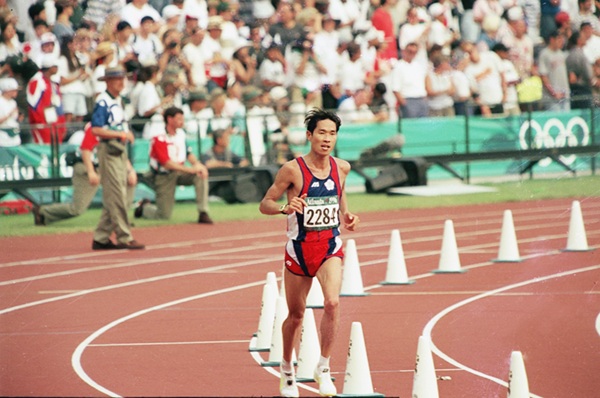
At the 1996 Atlanta Olympic Games, HSU competed in the marathon. His Taiwanese marathon record of 2:14:35, set the previous year, remains unbroken and is known in Taiwan as the “HSU barrier.” (Photo courtesy of HSU) |
The 1980s
Gi-Sheng HSU
Japan has long been one of Asia’s leading nations in distance running, with its unique ekiden culture and corporate team system. For some Taiwanese runners, Japan has become not only a place to compete, but also a place where they can grow. Taiwanese marathon record holder Gi-Sheng HSU was one of them.
Taiwan’s national marathon record still stands at 2:14:35. The mark was set more than 30 years ago by Gi-Sheng HSU, who competed for a Japanese corporate running team. Today, another Taiwanese runner is making headlines in Japan: Tzu-Chieh CHIEN, who moved from Taiwan to attend Sendai Ikuei High School in Miyagi before advancing to Chuo University, has already broken Taiwan’s national records in the 1500m and 5000m. For generations, elite Taiwanese runners have looked to Japan as a pathway to the world stage.
Although both Korea and Taiwan were once under Japanese rule, their marathon histories took very different paths. Korea produced two Olympic marathon champions — Sohn Kee-chung and Hwang Young-jo — while Taiwan has yet to produce an Olympic medalist in the event. HSU’s Taiwanese record from 1995 remains unbroken.
“I wanted to become stronger,” HSU says. “I learned little by little. Marathon running may be an individual sport, but you cannot become strong alone. That is something I truly learned in Japan.”
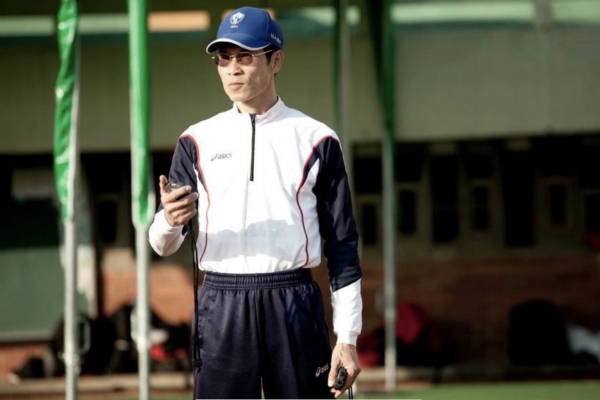
Now 62, HSU teaches at the Department of Competitive Sports at National Taiwan University of Sport. He was born on Kinmen, a small island governed by Taiwan just off the coast of mainland China, where military facilities and agriculture dominated daily life.
“It’s embarrassing to admit, but I used to run in shoes discarded by soldiers,” he recalls. “I only wore them for training and commuting to school. The rest of the time, I went barefoot. In high school, I was the best 1500m runner in Kinmen, but whenever I raced in Taiwan, I would finish near the very back. It was frustrating.”
Determined to improve, HSU decided to attend a sports college on Taiwan’s main island — now National Taiwan University of Sport. After graduating from high school, he spent a year working to save money for tuition.
“To study on the main island, I had to save money myself,” he says. “I trained every morning and evening for the annual regional championships and was eventually selected for the national championships, though only as a reserve athlete. I wanted to become stronger. I wanted to go to college. That was why I worked.”
Running may seem like a free and open sport, but athletes do not always have the freedom to run anywhere. Taiwan’s road-race regulations still reflect the island’s military history. The Kaohsiung Marathon, for example, includes a section that passes through a military fortress, requiring foreign participants to obtain special permission from senior military officials.
At college, HSU gradually extended his range from the 1500m to the 10,000m. In March 1985, during his first year, he earned selection for the World Cross Country Championships in Portugal. The field included Portuguese marathon champions Carlos Lopes and Rosa Mota, as well as some of the world’s greatest distance runners of the era, including Ingrid Kristiansen and the barefoot South African prodigy Zola Budd.
“There were so many famous athletes there. I even got Ingrid Kristiansen’s autograph. I still treasure that shirt today.”
HSU finished 257th. He represented Taiwan at the World Cross Country Championships for three consecutive years, but the gap between himself and the world’s best felt enormous. He finished 270th and 225th in the following years and began wondering how he could improve further.
The opportunity came during his third year at college, when Nagoya University of Commerce & Business offered him a scholarship to study in Japan.
At the time, Japan was in the midst of an unprecedented marathon boom fueled by stars such as Toshihiko Seko and Takeyuki Nakayama. For HSU, the chance to study there was unexpected. But the university also had ambitions of its own: it hoped to raise its profile at the All-Japan University Ekiden, one of Japan’s premier collegiate relay races, and challenge regional powerhouse Chukyo University.
“When I went to Nagoya University of Commerce & Business, I learned that track and field is about teamwork,” HSU says. “Even during interval sessions like 10 × 1000m repeats, my teammates would shorten the final repetitions and run alongside me. There are limits to what you can do alone.”
“In Japanese road races and ekiden relays, huge crowds line the streets and cheer for you. That gives you strength and courage. It was a completely new experience for me, and I trained as hard as I could. People probably thought I was a very unusual foreign student.”
Beginning in 1988, HSU ran the opening leg of the All-Japan University Ekiden for four consecutive years. He finished second on his leg in his second year and won the stage award in his third year. In his senior year, his team stopped Chukyo University’s bid for a 36th consecutive title at the Tokai Collegiate Ekiden. In 1989, he also broke Taiwan’s national marathon record at the Taipei International Marathon with a time of 2:17:15.
“I received a scholarship, benefited from coaching while competing, and gradually became stronger,” HSU says. “If you truly pursue something, you can achieve it.”
|
Now 62, HSU teaches at his alma mater, the Department of Competitive Sports at National Taiwan University of Sport. |
The Road to the Atlanta Olympics
HSU’s success in university ekiden racing soon attracted attention from Japan’s corporate teams, including powerhouse Asahi Kasei. But he ultimately chose Sagawa Express — now SG Holdings — which had only been established five years earlier.
“I wanted a team where I could continue developing under good coaching,” he says. “After speaking with the coach, I felt I could become stronger by competing alongside my teammates. If I joined an already powerful team, I wasn’t sure they would invest the same attention in me.”
Another fortunate factor was the presence of Masaki OYA, two years younger than HSU and one of Japan’s rising stars after breaking the national half marathon record. Training alongside OYA pushed HSU to the best performances of his career.
In 1995, at the age of 31, HSU ran 2:14:35 at the Beppu-Oita Marathon, setting the Taiwanese national record that still stands today. The following year, he won the Kaohsiung International Marathon to earn a place on Taiwan’s Olympic team. Later that year, OYA became the first Japanese runner in nearly five years to break 2:10 in the marathon and was selected for the Atlanta Olympics.
HSU finished 57th in Atlanta, but the memories remain vivid.
“For 16 years after I graduated from high school, my parents opposed my running career,” he says. “Then, in 1996 — the 17th year — they were finally happy for me. My company even invited them to Atlanta as a reward. They were happy that their son had received so much support — and that they themselves could travel overseas for free,” he says with a laugh.
After retiring, HSU returned to Taiwan and began teaching at his alma mater. Running has gradually become more popular in Taiwan, and public understanding of road racing has improved significantly since his youth.
Still, one belief has never changed.
“If you try, you can do it. If you do not try, you cannot.”
HSU, who broke Taiwanese records from middle-distance races to the marathon, has even proposed prize money for whoever eventually surpasses his marathon mark. And he has complete faith in the young Taiwanese challenger now studying in Japan: Tzu-Chieh CHIEN.
*This article was originally published in the July 2026 issue of RUNNERS magazine in Japan and is provided in English for RUNNET.
**************************
Enter Japanese races through Run Japan, the English-language race entry site for marathons and running events across Japan
※こちらから記事検索ができます。
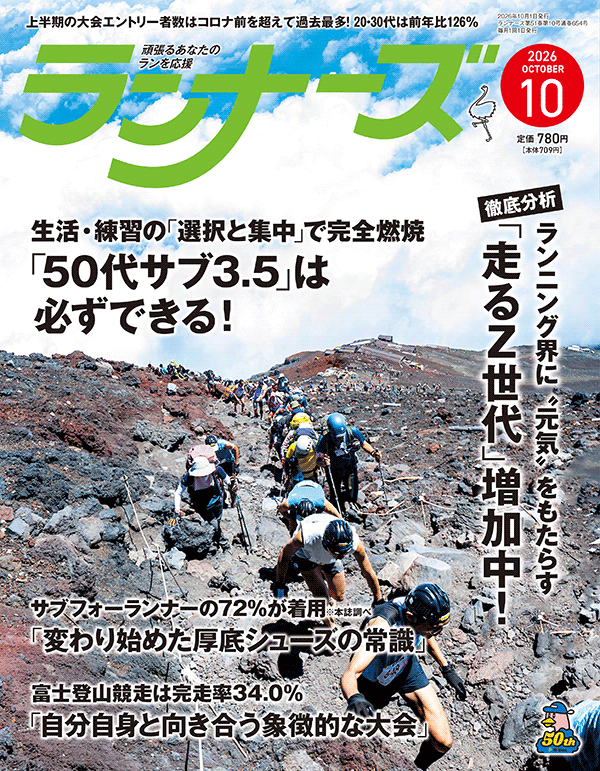
ランナーズ10月号 8月21日発売!
「走りたい」気持ちを駆り立てる厚底シューズ
ショップ店員が勧める注目の14足
「マラソン2時間切り」を掲げて2017年にナイキが初めて発売した厚底カーボンシューズは近年、速いランナーだけの “特別な存在” ではなくなってきています。本特集では幅広いランナーに厚底カーボンを勧める識者や愛用するランナーの声を紹介するとともに、ショップ店員が勧める注目厚底カーボンシューズ×14を掲載します。
本気で燃え尽きれば50代サブ3.5は必ずできる!
「本気で取り組めば、50代サブ3.5はかなりの確率で可能」。本企画では、一人のランナーの実話を通して50歳を超えてから初のサブ3.5をするためのヒントを紹介します。あわせて、「50代に必須の筋トレ」「スピード走&レース出場」など、走力を向上させたい50代ランナーにお勧めのトレーニングを本誌50年分から厳選して紹介します。
ランニング界に “元気” をもたらす
「走るZ世代」増加中!
いま、若者たちの間でランニングが新しいカルチャーになりつつあります。スマートフォンやSNSとともに育ち、青春時代にコロナ禍による活動制限も経験した世代。彼らはなぜ走り始めたのか。そしてランニングに何を求めているのか。データと現場取材を通して「走るZ世代」のリアルに迫ります。
本誌購入は年会費7,800円「ランナーズ+メンバーズ」がお勧め!
「ランナーズ+メンバーズ」は毎月最新号が自宅に届く(定期購読)だけでなく、「デジタルで最新号&2011年1月号以降が読み放題」「TATTAサタデーランが年間走り放題」「会員限定動画&コラム閲覧可」のサブスクリプションサービス! 年会費7,800円の超お得なプランです。